
Turn Fences Into “Dew + Seed Collectors” to Regrow Street Flora Nightly
 January 21, 2026
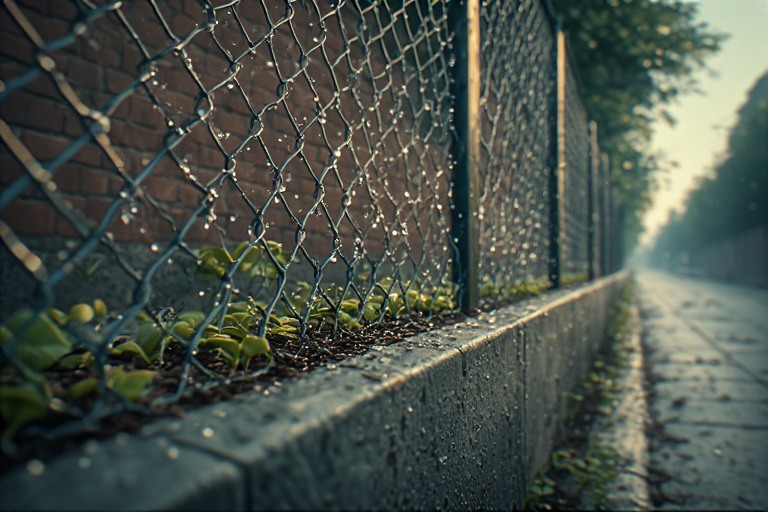
A DIY “Dew-Seed Trellis” can accelerate urban flora regeneration by combining a dew/fog-harvesting mesh with a seed-capture screen and a narrow strip of microtopography pockets that hold moisture at seedling height. The system targets the real bottleneck—germination and the first 2–6 weeks—by delivering frequent micro-doses of moisture, concentrating seed deposition, and keeping microsites humid without powered irrigation. If it works, a block can build passive reseed-and-rewater infrastructure instead of repeating one-off planting efforts.
Why this matters
- Cities and volunteers spend money and time on plantings that fail in the first month; improving early survival is the fastest way to raise “green per dollar.”
- Passive, modular strips can scale along fences and corridors, creating continuous habitat and cooling benefits without hoses, pumps, or heavy materials.
Evidence
- Fog collection using mesh nets is a documented passive atmospheric water harvesting method that can provide water for vegetation and other uses. https://pmc.ncbi.nlm.nih.gov/articles/PMC3357847/
- Reviews of atmospheric water harvesting summarize fog meshes and dew condensers as established passive methods that can collect water without external energy input. https://iwaponline.com/ws/article/24/11/3810/105774/Atmospheric-water-harvesting-as-a-sustainable-and
- A review of sustainable atmospheric water harvesting methods discusses technical aspects and performance of fog and dew collection approaches. https://academic.oup.com/ijlct/article/15/2/253/5718410
- Seed rain is measured using seed traps, and a 2023 review discusses seed-trap approaches and complexities in assessing seed rain in urban contexts. https://www.mdpi.com/1424-2818/15/9/1015
- Wind-dispersed seed deposition patterns have been quantified in field studies, showing non-uniform deposition that responds to surface and landscape conditions. https://pmc.ncbi.nlm.nih.gov/articles/PMC4246809/
- Microtopography affects infiltration and water retention by changing surface relief and flow connectivity, with documented effects on soil moisture and plant growth in experimental work. https://pmc.ncbi.nlm.nih.gov/articles/PMC10102350/
- Microtopography recreation has been reported to increase habitat heterogeneity and enhance soil moisture gradients, supporting restoration outcomes. https://pubs.acs.org/doi/10.1021/es303294n
- A Restoration Ecology paper reports microtopography can enhance water retention and soil moisture through increased depression storage. https://www.wetlands.com/s/Microtopography_SoilNutrients_RestorationEcology.pdf
- DIY sheet mulching guidance describes using cardboard/paper barriers plus mulch to suppress weeds and support soil building, reducing competition during establishment. https://extension.oregonstate.edu/catalog/em-9559-sheet-mulching-lasagna-composting-cardboard
- Urban forestry guidance emphasizes that soil and rooting environments are central to urban vegetation success. https://treecanada.ca/urban-forestry-guide/
- Build passive reseed-and-rewater strips instead of one-off beds.
- Concentrate seed landing and moisture delivery into engineered microsites (pockets), not uniform flat soil.
- Measure success at the bottleneck: seedling density and survival at 2, 4, and 6 weeks.
- Pair the trellis with weed suppression (light sheet mulch) to reduce early competition and evaporation losses.
What it means
Mechanism
Urban regeneration fails when seeds land but don’t stay, when water arrives in bursts then disappears, and when seedling-height microclimates run hotter and drier than the air people feel. A vertical mesh screen intercepts small amounts of atmospheric moisture during humid nights and also alters near-surface airflow, physically catching some windblown seed and creating a consistent deposition strip. Under the drip line, shallow microtopography pockets increase depression storage, slow surface flow, and create locally humid microsites. The system’s advantage is frequency and placement: small moisture pulses applied repeatedly to the same protected pockets where seeds are landing.
Risks & counterpoints
- Best objection: dew/fog yields are too small or too variable to matter in most cities, so the mesh adds complexity without changing outcomes.
- What would falsify the claim: in matched side-by-side strips, trellis + pockets show no improvement in pocket moisture persistence or seedling survival versus pockets alone over multiple weeks.
- What could reverse the story: a prolonged low-humidity drought; in that case the system still concentrates seed but may require a minimal manual “refill” (e.g., weekly bucket top-ups into pockets) to preserve the survival advantage.
What to watch next
- Humid-night correlation — higher survival in trellis pockets after weeks with humid nights confirms the “small, frequent moisture pulse” mechanism.
- Seed-deposition striping — visible post-wind-event seed accumulation along the mesh line confirms the seed-trap function.
- Heatwave performance — trellis pockets staying green while flat control strips brown out confirms microclimate and moisture persistence benefits.
Bottom line
If you build a fence-mounted mesh that repeatedly drips dew into microtopography pockets where it also concentrates seed, then urban revegetation shifts from one-time planting to nightly passive regeneration.